Site Search

July 8

The amazing Richard Gasquet backhand!


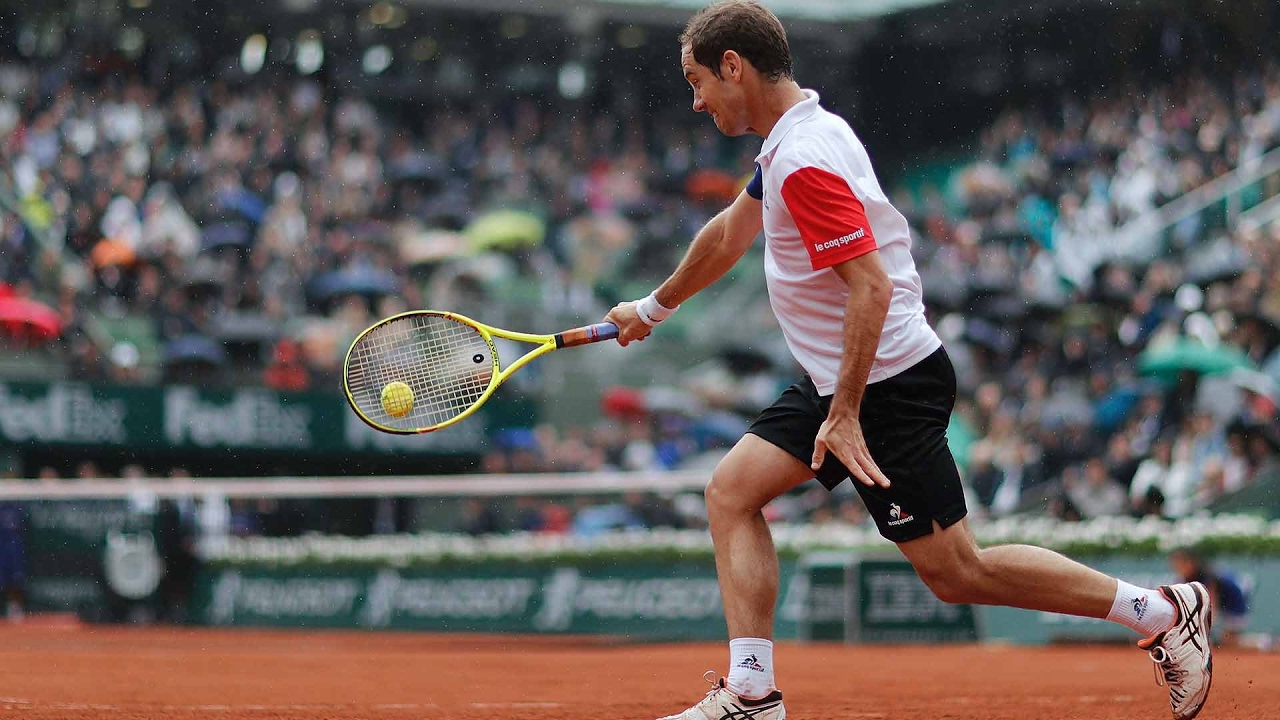
The victory of Richard Gasquet over Andy Roddick in the Wimbledon 1/4 final showed the world what a fantastic player he is and also showed us the amazing Richard Gasquet backhand. Gasquet was an unbelievable talent waiting to ignite at any time and unfortunately for Roddick, it was the Richard Gasquet's backhandWimbledon 1/4 final 2007. At times Roddick was looking up at his coach Jimmy Connors in sheer despair, as yet another exquisite Richard Gasquet backhand down-the-line ripped passed him at a ridiculous speed. Gasquet and his backhand were on fire and as a result, he was almost hitting winners at will.

The shot that had the spectators literally gasping was his single-handed topspin backhand - so lets take a look.

The Shot
The Richard Gasquet topspin backhand is typical of the way the modern day single-handed shot is evolving. Very high preparation at full backswing, looping round and down before contact. This is more prevalent in todays game - though his shot is still extreme.

The high take-back has evolved as a result of some players trying to squeeze a little more power out of their shot. We used to see it on balls bouncing around head height - but more and more we see it on general backhands too. I was really interested to see at this year’s French Open, how high some of the South Americans were preparing for the shot. (see ‘Backhand racquet preparation - can your opponent see your racquet tip?‘)

As youngsters we were told not to prepare too high as this would cause problems - and the high take-back technique is not something I would readily recommend to club standard players, as perfecting this involves impeccable timing. The images of the Gasquet backhand above show how far his racket needs to drop from full preparation to the below the ball position. This timing is not for the faint hearted and if not executed perfectly, will lead to a late struck, handcuffed shot.

Gasquet’s bckhand is further complemented with excellent shoulder turn, great knee bend, perfect use of his non-racket arm and a spot on striking position.

Take a look and savour it!


, , , , ,

bookmark bookmark bookmark bookmark bookmark bookmark bookmark bookmark bookmark bookmark bookmark

By john key ::::: Permalink :::::
See Related Stories In: Coaching Tips

July 8, 2007 at 1:22 pm
RSS Icon


27 Comments

July 9, 2007 @ 1:45 pm

How nice to see such a brilliant single handed backhand as Gasquet’s, and how well your photos demonstrate his technique. I think the two fisted backhand sometimes looks awkward compared to a free flowing single handed shot. I wonder if Gasquet, Federer,Henin and others will inspire a new generation of single handers in the future. Congratulations on a great site!


August 24, 2007 @ 2:09 am

What an amazing site! The design is gorgeous and I love all the information. Thank you also for having a feature on Richard Gasquet’s backhand, which, IMO is the best in men’s tennis today. It’s certainly the most beautiful to look at.

cheers
Lyekka

http://www.your-serve-tennis-shop.com


August 24, 2007 @ 12:32 pm

Hi Lyekka,
Thanks for your kind words about the site.

Richard Gasquet’s backhand is winning fans the world over and deservedly so!

John

p.s. I took a peek at your tennis shop/auction site - looks great!


September 28, 2007 @ 6:02 am

This is a wonderful tennis web site. It was a brilliant idea to focus on the backhand, esp. since it is such a difficult shot for so many players. I really appreciate being able to study the great one-handed backhands of earlier pros as well as the pros playing now.


September 28, 2007 @ 7:37 am

Hi Terri,
Thanks so much for the compliment, they are always appreciated. It’s great to know that the website is proving to be a useful tool.

I’ll continue to add new content weekly so keep checking in.

John Key


October 1, 2007 @ 5:10 pm

Curious to know what is Richard Gasquet’s backhand grip.

Eastern Backhand Grip? Semi-Western Backhand Grip? or other?

Thx.


October 1, 2007 @ 9:07 pm

Hi there,

There’s a fine line between the various grips and hopefully the image below might help.

Whilst the Richard Gasquet backhand is undoubtedly a heavy topspin shot, his grip is not quite as far round as Justine Henin’s or Gustavo Kuerten’s. Henin uses a Semi-Western backhand grip and in my opinion Gasquet is an Eastern, but only just. He is nudging ever-so-slightly semi-western compared to Federer’s more obvious Eastern.

John

Justine Henin and Richard Gasquet


October 2, 2007 @ 9:22 pm

Thanks for the clear explanation.

Often my backhand shot gone bad ’cause I didn’t fully switch to semi-western (my preferred grip) and stuck between semi-western & eastern. Why? Because ball coming fast @ me and I was hurried.

Two questions:
1) Is my problem common? Is there a general solution to my problem?
1) Should I use my non-hitting hand switch grip first, then rotate shoulder & reach back? Or first quickly rotate shoulder, reach back, and then switch grip?

Thx.


October 3, 2007 @ 8:42 am

Hi,
Firstly, whether you use a Semi-Western backhand grip, an Eastern or something that sits on the border of the two is fine, and will not cause you problems. However, you must make sure that you are organised in time to play your shot and not caught mid preparation and mid grip change when the ball arrives. The following will help:

1. Don’t think of the grip change, racket take-back and shoulder turn as separate elements of the preparation for the shot. Try to think of the preparation as one complete element. In other words, the grip change happens immediately and at the same time, the shoulder-turn and racket take-back join in the fun! The top half of your body turns like an opening door with all the preparatory elements flowing together.

2. The most common problem when getting caught hitting late and hurried is not getting your soldiers in order in time. This can be due to not recognising a faster or deeper ball from your opponent, complicating the preparation, not reading your opponent’s topspin, not abbreviating the shot when you should, not knowing when to forget the drive as a slice is needed etc.

Some players prepare perfectly and then hang around too long in the loaded position. Once you have prepared correctly, remember to then look for the ball with your racket making sure your contact point is comfortably in front of you.

Take a look at this frame-by-frame virtual animation of me hitting a topspin drive. For this example I have purposely kept things simple and not prepared too high. As discussed in the initial post. The high Gasquet style take-back is fine if you’re advanced and looking to generate huge power with perfect timing, or maybe you’re on a high bouncing clay court. There are stacks more like this example in our Hot Spot zone:

Topspin Drive Example

I hope this helps.
John


October 23, 2007 @ 7:26 pm

Question: I could only slice with backhand and started to learn single-handed backhand drive a while ago. Having 2 problems right now.

1) Since backhand slice & drive are 2 different grips, I often have trouble to determine which grip I should go with when ball coming to my backhand. Esp. when ball is high when I should slice, yet get caught in a backhand drive grip position. How can I deal with this?

2) I can drive the ball with single-handed backhand with decent pace and accuracy - when ball coming in slow. When ball coming fast at me, my backhand drive becomes that much more error-prone. Any pointers?

Thank you.

- JW


October 24, 2007 @ 12:25 pm

Hi Jason,

In answer to your questions:

1) To avoid getting caught with a drive grip on a slice shot, firstly try to make an early decision as to whether you will slice or drive your shot and then make the grip change as soon as you begin the racket preparation. If you hang around too long trying to make your mind up which shot to play, the grip change becomes more difficult.

Make sure that you are comfortable with each grip by grooving them in, so they become second-nature. You can do this by initially only hitting slice (with the correct grip), then only drive. Once the grips feel good in isolation, start alternating the shots and grips.

2) This is one of the most common backhand problems and is nearly always caused by the ball handcuffing you by getting too close to your body. Remember, a ball that is struck comfortably in the hitting zone will normally be controlled, one that is struck late will not. Here’s your checklist to avoid having problems when receiving a faster ball:

Are you alert and reacting to what’s coming towards you?
Are you light on your feet?
Are you getting your racket back in time?
Having prepared, are you starting your forward swing motion in time?
Is your technique too complicated?
Are you adjusting to a faster surface correctly?
Are you trying to drive when you should be slicing (shot selection)?
Are you recognising when to abbreviate the shot to avoid trying to fit in the full backswing when it’s not possible?

Good luck,
John


April 25, 2008 @ 12:59 am

Hi John,

You are so true with the comment on timing: after switching to single-handed it has taken me more than a year to get the timing with the high preparation and that’s only for sitters.

My question is: what do you think are the differences in preparation and execution of Gasquet, if any, when returning serve, especially when short on time?


April 27, 2008 @ 9:30 am

Hi Tenny,
I think the film below demonstrates well how Richard Gasquet returns serves of varying speeds.

The first clip shows Richard with a fair amount of time to play his return, so his technique is his usual pronounced stuff (big backswing etc.). In the second clip he has much less time to play the shot, so we see an abreviated backswing and follow-through, allowing him the time to still meet the ball comfortably in front. The final clip shows Richard with even less time, so he correctly chooses to chip the shot.

I hope this helps and good luck with the single-hander.

John


May 3, 2008 @ 10:03 pm

Thanks John! That does help if it isn’t too much trouble do you have a slow motion version of the second return of serve backhand, those are the ones I lack the consistency on and would like to take a closer look at the swing! Thanks again!


May 6, 2008 @ 6:15 pm

Hi Tenny,
As soon as I get a chance I’ll upload a slo-mo version of the second return.

All the best.

John

Here it is - enjoy it!


June 30, 2008 @ 8:20 pm

Hi John,
Thanks for the great article. I recently switched from a two-handed backhand to a one-handed. With my two-handed, one of my best shots was my backhand topspin lob, but with my one-handed backhand, I can’t get a good lob with enough control and topspin. Do you have any tips for more control and topsin? Thanks

Jared


July 1, 2008 @ 1:23 pm

Hi Jared,
You may find that when you had a two-handed backhand, you used your other hand (non-racket hand) to great effect when hitting a topspin lob. David Nalbandian is an excellent example of someone who uses his other hand really efficiently when hitting angles and lobs. Having said that, there is no reason why you can’t hit a great topspin lob as a one-hander. Gasquet, Federer, Robredo etc. prove this.

One common mistake is to not commit fully to the shot for fear of over hitting. Make sure you attack up the ball with a steep low to high action. The tip of the racket must zip up the back of the ball with a slightly closed racket face. The initial part of the shot (preparation) should look pretty much the same as your topped drive with the difference being the steeper trajectory. This way your opponent will not see the lob coming from your set-up. Normally an abbreviated follow-through is all that’s required.

Good luck.
John


August 29, 2008 @ 5:04 am

hi John!

Just came by and saw your article, it was great especially seeing you answer those questions about one handed backhand that also do concern me, but I do have one thing a little unsure about.

In a full tennis match other than slicing do the one handed backhand change between semi-western and eastern? What would happen if I did that?


August 29, 2008 @ 10:33 am

Hi there,

I think that some players will vary the exact position of their grip depending on whether they need a little extra whip on the shot. I don’t think that because you primarily use an Eastern grip that you should not drift towards a Semi-Western for some shots.

I also think that in some situations, a player who primarily uses a Semi-Western might want to flatten the shot out (maybe for a block shot) with an Eastern grip or further.

To summarize, I don’t think that it is set in stone that you can’t improvise your grip. Do what works for you.

John


March 17, 2009 @ 12:38 am

Unfortunately, the one-handed backhand is dying out. No matter how much people insist it isn’t. With new racquet technology, the two-handed backhand provides much more stability and control. It is easier to hit also because the footwork for the one-handed backhand is more strict than the two-handed one. And since the game of tennis is becoming faster with new technology, it is hard to hit a full out one-handed topspin backhand shot. I rarely see people use one-handed backhands in tournaments at the higher level now. The cons just seem to outweigh the pros.


March 17, 2009 @ 7:17 am

Interesting comment David.

I guess it would be interesting to see how many top youngsters at the u/14 and u/16 international events are are still single-handed. This would be a good pointer for the future.

In my opinion some of the best backhands of the past 5 years have been single-handed: Henin, Gasquet, Federer. They all had backhands that they could hit full pace.

Whether you are right that the single-hander is dying out would make an interesting study.

John


April 1, 2009 @ 8:20 am

My tennis racket required an overgrip to accomodate the appropriate diameter for my hands, but this has resulted in a rounded handle and I can’t really feel the bevels. Will this be a problem for achieving the right grips, especially for a backhand?


April 1, 2009 @ 3:13 pm

Hi Christian,

This is a really good point.

An over grip like a Tourna Grip shouldn’t round the bevels too much but a replacement grip (normal thicker grip) over an existing grip can round things quite a bit. Some people find that the lack of reference points (edges/bevels) can make finding the correct grip position a bit difficult. If it continues to be a problem for you, one technique is to remove the existing grip and build up the handle with strips of card (full grip length), fixed in place with dabs of glue. Assuming the card is the right thickness, when the grip is put back on over the card you have the right size and still have the bevels. This is tricky but absolutely possible - it’s worth a go if you can’t get on any more with your racket due to its rounded handle.

John


January 17, 2010 @ 11:45 am

Hi great article and great site,

i would have a question about the way to compare and to choose between one or two handed backhand as myself cannot decide between the two

thanks
cheers


January 17, 2010 @ 12:28 pm

Thanks for the kind words of encouragement.

Nowadays more and more players who are new to the game seem to immediately go the double-handed route. As players start the game at such a young age, using the second hand has obvious strength advantages and of course, the majority of those players then stick with two hands throughout their playing days.

I personally started with a single-hander and stuck with it. Maybe you need to get a coach to take a look at you and see what you do more naturally. Both styles have advantages and disadvantages.

A double-hander has the strength advantage but with the lack of reach compared to a single-hander, requires great footwork and anticipation. Often a single-handers slice is more natural but a double-hander can create great angles (if the second hand is used well to help wrap the racket head around the ball - see Nadal and Murray). etc. etc.

Get some guidance, follow your gut instinct and stick with it. Try not to keep changing backwards and forwards as this will obviously slow down your progress.

Good luck.

John


February 10, 2010 @ 5:40 pm

Hi,

When people serving to my BH and I slice back, I do NOT have to change grip which saves me time; when I return with BH drive, I first change grip (semi-western FH to the equivalent of semi-western of BH) which I often find either no time or not enough time to do so, causes bad BH return drive.

Question: do you (or other good 1-handed BH players) always change grip 1st and then return with BH? Or you sometimes just block it back without grip change? Or yo do both depending on situations?

Thx.


February 11, 2010 @ 8:15 am

Hi,

This is a good question. The first thing to do to help this is to wait in the return-of-serve position with a grip that sits nicely between your forehand and backhand grips. This way you have the same amount of grip change (movement) should you have to hit one or the other. Some players at club level might wait in the return position with a grip nearer to the forehand, but this can cause a problem once you start to receive faster serves on the backhand.

As you get more confident with you speedy grip selection you will be able to hit abbreviated drives off of fast serves - until then a block or slice is the safer option. Remember - even the pros are forced into a block return when the serves dictate it.

Also, don’t just think full drive or block. There are many abbreviated versions you can use depending on the lack of time. You can abbreviate the backswing to various levels and also the follow-through (see Gasquet in the film above to see a shortened return swing).

A good way of practicing returning a fast serve and therefore the grip selection (even if your practice partner doesn’t have a fast serve) is to stand closer for your returns. This will make the serve appear faster and give you less time. When you move back to the normal return position you’ll appear to have more time.

Good luck.

John


post a comment

Please leave a comment below.